
This Holden Trax ECU repair began with a no-crank condition. The ignition was on, but the engine would not respond. This case study outlines our diagnostic process, from the initial scan through to a component-level repair of the engine control unit (ECU).
Initial Scan of the Holden Trax ECU Fault
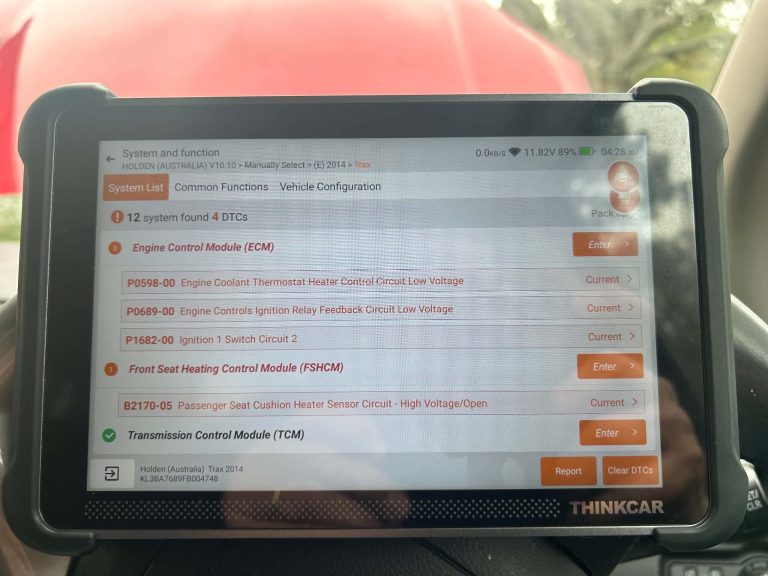
We began with a full-system scan. We were able to communicate with the engine control module (ECM), and the scan returned several active fault codes, including the engine controls ignition relay feedback circuit and the ignition 1 switch circuit. A seat heater circuit fault was also logged, which was unrelated to the no-crank condition.
Sourcing Wiring Diagrams for the Holden Trax
Wiring diagrams specific to the Holden Trax were not readily available. Through further research, we established that the vehicle shares its platform with the 2014 Buick Encore. The Encore diagrams matched the vehicle’s circuits, which gave us a reliable reference for the rest of the diagnosis. You can find the ECU wiring diagrams here.
Isolating the Fault Before the ECU Repair
The scan data indicated that the engine controls ignition relay was not being energised. According to the wiring diagrams, the ECU controls this relay by switching its control circuit to ground.
We removed the relay and tested its supply. Both the coil feed and the contact feed were present and correct. This narrowed the fault to two possibilities: a break in the control wire between the ECU and the relay, or a failure of the ECU to issue the command.
To distinguish between them, we removed the ECU and applied a direct ground to the relay control pin at the connector. The relay activated immediately, which ruled out a wiring fault and pointed to the ECU.
Before condemning the module, we verified all of its operating requirements, including power supplies, grounds, ignition signals and CAN bus communication. All were within specification. The ECU was confirmed as faulty, and when reconnected to the vehicle it was completely unresponsive.
Replacement ECU Programming Challenges
We sourced a used ECU from another 2014 Holden Trax. Its part number differed slightly from the original, although the unit was otherwise identical. We unlocked it using an OBDSTAR DC706 and attempted to program it to the vehicle through Techline Connect.
Techline Connect rejected the unit because of the part number mismatch, so standard programming was not possible.
Cloning the Original ECU
Our alternative was to clone the original ECU’s data onto the replacement. However, the original unit was entirely unresponsive, and its data could not be read. Recovering that data meant repairing the original module first.
Holden Trax ECU Bench Repair
We opened the original ECU and powered it on the bench using a controlled supply.
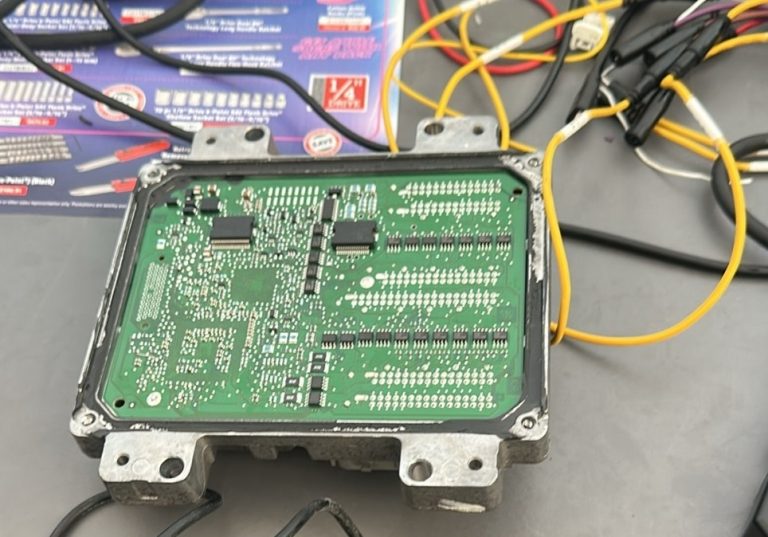
Voltage measurements across the board were abnormal. The highest reading we could obtain was 0.6V, which indicated either a failure in the power supply circuit or a fault such as a poor solder joint.
We confirmed that the 12V inputs were present and traced them across the PCB to the power supply IC. At the IC’s outputs, several of the heavier power traces showed unusually low voltage, suggesting a short or excessive load on those rails.
We removed a capacitor from one of the affected rails, and the ECU immediately returned to normal operation.
The Result: A Completed Holden Trax ECU Repair
With the original ECU functioning again, we could read its data. Using the OBDSTAR DC706, we cloned the original ECU’s contents onto the second-hand unit. This gave us a working module that the vehicle accepted, despite the different part number.
We installed the cloned ECU in the vehicle, and the engine started.
Key Takeaways From This ECU Repair
- Systematic testing is essential. Fault codes provide direction, but only verifying each circuit confirmed where the fault actually lay.
- Component-level diagnosis can prevent unnecessary replacement. A single failed component can disable an entire module. Locating it allowed us to recover the original data and complete the repair.
- Appropriate equipment is critical. Accurate wiring information, bench power supplies, a quality scan tool and ECU cloning equipment were all necessary to complete this job.
Need ECU Repair or Auto Electrical Help?
If your vehicle has a no-crank condition, has lost communication with its ECU, or has an electrical fault that remains unresolved, our team can help. Contact us to book your vehicle in. We prioritise accurate diagnosis so that repairs address the root cause, whether that means a Holden Trax ECU repair or any other make and model.